Monday, November 28, 2011
A brief note re wind at FAC
Having spent a few hours last night in the wind up here on the hill at FAC, I have been reminded what an annoyance all those wispy bits of hair blowing around in front of my eyes are. For those of you who have hair that blows, it's a good idea to bring a headband or similar as it's a right pain.

Sunday, November 27, 2011
Info for Dancers - STRUT Seed Residency, November/December 2011 R&D
Hi Bianca, Jess, James and Hellen
I am posting the info you will need here on the blog so you will always know where to find it :)
SCHEDULE FOR DANCERS
Please be ready to begin at the start times - arrive early if you need time to relax etc.
7-9pm Wednesday 23 November
Q&A at Fremantle Arts Centre (FAC)
10am-10pm Tuesday 29 November
Hellen will join Adelina, Simon and I at some stage
4:30pm to 10pm Thursday 1 November
Training, research, practice etc
Hellen will be late
4:30pm to 10pm Sunday 4 Dec
Training, research, practice etc
2 to 10pm Monday 5 Dec (showing from 8pm)
Preparation for showing
James will be arriving late and will make up this time on another day
WHAT TO BRING
I am posting the info you will need here on the blog so you will always know where to find it :)
SCHEDULE FOR DANCERS
Please be ready to begin at the start times - arrive early if you need time to relax etc.
7-9pm Wednesday 23 November
Q&A at Fremantle Arts Centre (FAC)
10am-10pm Tuesday 29 November
Hellen will join Adelina, Simon and I at some stage
4:30pm to 10pm Thursday 1 November
Training, research, practice etc
Hellen will be late
4:30pm to 10pm Sunday 4 Dec
Training, research, practice etc
2 to 10pm Monday 5 Dec (showing from 8pm)
Preparation for showing
James will be arriving late and will make up this time on another day
WHAT TO BRING
- warm clothes (it can be very cold and windy up at FAC on the hill at night).
- white or light-coloured clothes to work in projection environments (from casual to 'dressed'). Bring a couple of different options if you can. Please let me know asap if this will be a problem.
- Water in a bottle.
- Hat, sunscreen etc for outdoor work in the day.
- Head torch (if you have one).
- Comfortable clothes for training.
- Notebook etc if you are inclined to want to write things down.
FOOD
We will be having half-hour breaks where I will be providing food as this is the easiest, cheapest, quickest option. If you have any particular requirements let me know asap. If you are the type of person who needs to snack, please bring your own.
INVITATIONS
We will be presenting a showing of our process on Monday 5 December. The way we will be working around the building means that we will have to limit our audience. Also, I am not keen on inviting a huge amount of people at this point as the work is in a vulnerable stage of development. That said, I am more than happy for you all to invite people who you would like to see the work or your work in this context. Please do so by email and either give me a list in person or send a list through to myself and Jo Pickup so we can give priority to these people. I would love to be more open about inviting people, but due to the many constraints of the working process we can not this time.
PROGRAM
I am intending to make an A4 program with notes and information about the work. I will also be crediting you and the other people who have had a hand in getting the work this far. I apologise for the lack of listing of your names in some of STRUT's emails. I have asked them to include all names in subsequent communications and this is of course fine. At present I don't intend to include biogs (mainly because I don't really have time and energy to chase you all) but if this is particularly important to you I will do it.
PUBLIC TRANSPORT
Apparently there is trackwork happening on the Freo line over the next few weeks. Please let me know if this will be a problem for you so we can organise lifts etc.
OTHER NOTES
I will try to get some posts up about the process, but I'm not sure if I will have the time. The process is very intensive as we are doing many sessions each day including physical practice, research (at this time we are focussing on different modes of awareness in order to be prepared to respond to the audience and environments), technical development (with projectors etc), and investigations at night with the projections in the architecture. Much much more to be done!!
See you all soon.
Michelle
Sunday, January 2, 2011
Description of Process - The PNG Work
THE LAB (Block 2): Evening Sessions
Over the course of the lab it became more obvious that there are particular things that need to happen in a particular order to introduce the work to new collaborators and also to develop the knowledge and experience of those already within the process.
During the eight days of the lab, collaborators could book themselves in to any number of sessions which created a staggered approach to the research process and processes of learning. Having to negotiate the experiences of people at different levels of knowledge was an interesting and useful experience in determining how the structure of the work can support constant change.
From the work done during the lab, it now seems to me that the strongest understanding and integration into the already evolved structure happens in the following ways:
- INTRODUCTION TO THE WORK
This is a discussion between me and the artist(s) being introduced to the work. It involves a very personal account of how the work has come about and also includes discussion of the conceptual bases of the work, the showing of video documentation, reading from a variety of source materials, story telling, illustration of points etc.
This session serves to give the collaborators and understanding of the breadth and depth of the work and allows people to start to connect with some of the themes and materials in their own ways.
The session is often conversational and responsive to the questions and interests of the collaborator(s). It also serves to establish trust in the process and in me as the creator of the work. - TECHNICAL DEVELOPMENT - Learning the projection equipment and potential for projection environments
It is important to introduce the practical/technical side of the work immediately so that the collaborators feel that operating and moving projectors has the same level of importance as performing. It also allows the possibilities for changing the projection environments to be more easily incorporated into the scores.
Projection skills must be developed alongside knowledge and experience of the performance element.
Doing this work first also provides information about what the environments might look like from an audience perspective - which is very useful knowledge for a performer. - INTRODUCTION TO SCORES - BASIC SCORES
Each collaborator who wants to potentially 'perform' begins with the 'basic scores' which are a series of building blocks that will provide material for the intermediate and advanced scores. The basic scores allow the performer to fully experience their own embodiment in the environment while not necessarily being fully aware of what is happening around them. The experience of enacting these scores is 'deep' in that the performer is fully immersed without interruption.
The connection with the built environment (including moving images) comes from the conceptual connection between the scores and the materials (which have been developed during previous research and are largely controlled by me at this stage). This also means the performer is not overloaded or required to activate multiple awarenesses in this early part of the process.
The responsibility for creating and developing the visual-spatial context for the performers lies with the rest of the group (anyone not 'performing'). At this point collaborators may either take on the role of 'performer' OR 'projectionist'.
The basic score phase for any collaborator comes to an end when that person reaches a 'crisis point' - a point where they are too 'full'. At this point decision-making within the context of the scores becomes impossible through seeming meaninglessness. - INTERMEDIATE SCORES
The basic scores are now fully embodied and able to be accessed at any time by the collaborators which allows the intermediate scores to be focus on expanding the awareness of the collaborators to include the projection environment, other collaborators and audience members. Practically, the scores develop the possibilities for moving between the roles of 'performer' and 'projectionist', being able to quickly (and at will) move in and out of different perforative 'states', and begin developing the possibilities for relating to audience members. - ADVANCED SCORES
The advanced scores represent a point of full integration of the collaborator's abilities to respond to the environment, the group and the audience members. The scores are created and controlled by each collaborator and may continue to develop and change during the course of a 'performance' in response to the changing nature of the work as a whole. By this stage the collaborator will be comfortable accessing multiple levels of awareness and be able to make their own decisions within the context of the work. - FACILITATION
When a collaborator reaches this point, they are able to lead new collaborators through the basic and intermediate scores.
POINTS TO CONSIDER
- It should be possible to 'perform' the work for a general audience with a group of collaborators some of whom are new to the process (exploring the basic scores) and some of whom have had time to progress further providing a balance is achieved. Without a balance, the aim of the work to respond to the changing environment and audience members would not be achieved.
- This is a process that takes TIME and the commitment of PEOPLE. The equation involving people and time seems to strike fear into the hearts of many funders and support bodies in Australia. We can not let this deter us. This IS important work - both at research level and in the eventual shape of an ever-changing 'work' that can be presented.
- At present I am the only one who has reached the point of being able to facilitate the development of the work (point 6 in the pedagogic structure). Adelina Larsson has completed her explorations of the basic scores and is now working on intermediate scores. Everyone else is doing amazing work with the basic scores, both as 'performers' and 'projectionists'.
- How the pedagogy is expressed (above) may appear hierarchical and imbalanced with regard to power. I will continue to address this issue and will begin by writing a post about it soon.
- In many ways this work is my response to being in this world and is also the tangible and 'visible' manifestation of my practice as an artist - the proverbial tip of the iceberg. I do not seek to separate myself or my life from my art or from this process. In this way, for me (as probably for most artists), the work is deeply personal even though it is about collaborating and maintaining a cogent structure collectively. Maybe this is paradoxical?
Happy new year to all!
Mich
Wednesday, December 22, 2010
Research - 8 Dec
The PNG Work - Research 8 December from Michelle Outram on Vimeo.
This was the most difficult evening as we were dealing with the flattest surface while trying to create a 3 dimensional environment using light!!The footage is also seriously degraded at this point.
Monday, December 20, 2010
Afternoon Sessions - overview
While a number of different ideas relating to improvisation were explored in the afternoons, most sessions followed the following structure:
- discussion with the group about expectations and responses to previous sessions;
- warm up (physical with occasional vocal)
- exercises chosen to stimulate the senses, provoke thought and provide building blocks for the rest of the session;
- performances; and
- structured feedback relating to the performances.
It is also important to note that feedback took place after each exercise also and forms one of the major learning and group cohesion tools when working in this way.
Also the final two session in the series were quite distinctive and were structured differently.
It was important to me (Michelle), as the facilitator, to continually be responsive to the group. This meant I would propose a focus for the session after listening to the thoughts of the group in the initial discussion. I was able to plan some initial exercises during the warm up and then continue to respond throughout the sessions. This approach generally seemed to work well and worked particularly well when the group responded clearly and critically to the exercises.
At times I was able to step in as a 'participant', but there were times when I was more interested in watching the structure unfold.
Afternoon Sessions - documentation
I chose not to visually document the afternoon sessions, though I have written down the things we did and how it all progressed. I will start posting descriptions shortly.
It would be especially lovely if those of you who were there could write a little bit about the experience - what we did and any thoughts or responses.
It would be especially lovely if those of you who were there could write a little bit about the experience - what we did and any thoughts or responses.
Thursday, December 16, 2010
Thank you to all who participated

In alphabetical order: Bronwen Kamasz, Emma McIntyre, Hellen Russo, Janette McGinty, Jenna Downing, Jia-Jen Lin (Taiwan), Katya Shevtsov, Leah Rucks, Lisa Carrie Goldberg, Marnie Orr, Mia Holton, Michelle Outram, Peter Dreisiger, Pilar Mata Dupont, Renae Coles, Tarry Gill & Vahri McKenzie.
This picture leaves me 'hanging' for the next instalment!
Research - 7 Dec
The PNG Work - Research 7 Dec 2010 from Michelle Outram on Vimeo.
Three camera view. Not sure if this is useful or just confusing...
Research - 6 Dec
The PNG Work - Research 6 Dec 2010 from Michelle Outram on Vimeo.
I've gone for the multiple angles as it seems to show the work and the possible multiple views best for the purpose of documentation.
The 'Support Material' created in March/April
The PNG Work - Support Material from Michelle Outram on Vimeo.
NB. You can turn HD on and off depending on the speed of your connection.
Vimeo Link - click here
This is the link to the Vimeo 'album' with PNG Work stuff. I will also embed the videos here. If you don't have a spectacular connection to the internet, you may want to uncheck the HD symbol as this will allow you to watch the videos in standard def. (I think).
I haven't quite got the documentation from Wednesday 8 December up yet. It is coming...
I haven't quite got the documentation from Wednesday 8 December up yet. It is coming...
Friday, October 29, 2010
IMPROVISATION LABORATORY

Bodyweather Workshop, Dartmoor, UK, 2010. Led by Marnie McKee & Rachel Sweeney. Image by Michelle Outram & Manuel Vason
includes
BODYWEATHER TRAINING (led by Marnie McKee)
IMPROVISATION RESEARCH (facilitated by Michelle Outram)
WHEN
BLOCK 1: Friday 19 to Monday 22 November
BLOCK 1: Friday 19 to Monday 22 November
BLOCK 2: Wednesday 1 December to Wednesday 8 December
WHERE
Fremantle Arts Centre
BACKGROUND
This laboratory is being offered as part of Michelle Outram's residency at Fremantle Arts Centre. Michelle is currently researching methodologies for developing large-scale improvised performance installation environments and would like to share this research (and associated practice and training) with other practitioners from a variety of backgrounds and levels of experience.
STRUCTURE
The lab is structured as a series of non-compulsory sessions (three per day – see next page for times and descriptions) so that artists can choose how much to be involved, work around other commitments and/or to be able to focus on areas of interest within what is offered. Full (or significant) participation is encouraged as Michelle is interested in the notion of working 'at capacity' and exploring the paradoxical relationship between exhaustion and energy in the creative process, however, all levels of participation will be supported.
REGISTRATION
Please email Michelle (details below) clearly stating which sessions you would like to attend. This will help us plan the laboratory. Places for morning training are limited. Please also very briefly state your relationship (if any) to improvisation and to Bodyweather.
COST
The artists are offering this laboratory at no cost in a collegiate and skill-sharing spirit, but if you'd like to make a financial contribution, that can also be arranged.
CONTACT
MICHELLE OUTRAM via email, phone, skype, fb etc
email: michelle at michelleoutram dot com (you know the deal)
CONTACT
MICHELLE OUTRAM via email, phone, skype, fb etc
email: michelle at michelleoutram dot com (you know the deal)
DESCRIPTION OF SESSIONS
MORNING SESSIONS: 1000 TO 1300 (arrive by 0945)
MORNING SESSIONS: 1000 TO 1300 (arrive by 0945)
NB. There will be no morning sessions on 20 and 21 Nov.
BODYWEATHER – MB – led by Marnie McKee (nee Orr)
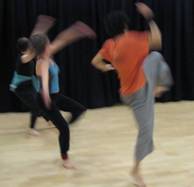
MB (which stands for Mind Body, Muscle Bone) is a workout session based on the walking, working body. MB is designed to develop individuals' strength, flexibility, coordination, balance, agility, stamina, and relationship to gravity, space, time and the working group. MB provides physical and verbal tools for generating dynamic space. It forms the foundation of Bodyweather training and philosophy. Bodyweather is a broadbased, comprehensive physical training which cultivates a conscious relation to the state of constant change inside and outside the body. Founded in Japan by butoh dancer Min Tanaka and his Mai-Juku performance group in the 1970's, Bodyweather is an open investigation that can be relevant for anyone interested in extending their physical practice, and creative practice generally. (Description provided by Marnie McKee.)
AFTERNOON SESSIONS: 1400 to 1700
IMPROVISATION PRACTICE – EXERCISES AND EXPLORATIONS – facilitated by Michelle and guests

Research in Real Time Composition with João Fiadeiro, Lisbon 2010: A series from session in the studio with João Fiadeiro, Vera Sofia Mota, Carlos Oliviera, Francisco Macias, Isabel Simões and Mariana Santos
These sessions will combine exploration of a variety of techniques and approaches to improvisation with the opportunity to practice performing for a group of peers. Sessions will be focussed around areas of interest and could include working from attention to texture and sensation, investigating memory/imagination or the role of 'fiction' in protecting the performer. Please contact Michelle if you have a particular interest and would like to lead a session.
EVENING SESSIONS: 1830 to 2130
RESEARCH – IMPROVISATION FOR FILM INSTALLATION ENVIRONMENTS – facilitated by Michelle

Research undertaken in March 2010 at Fremantle Arts Centre: Michelle Outram, Adelina Larsson, Simon Wise, Daniel Portelli, Hayley Bahr, Mia Holton, Maitland Schnaars, Carly Armstrong and Sarah Neviille
The evening sessions will focus on Michelle's current research project – methodological investigations toward the creation of The PNG Work which will examine Australia's relationship with Papua New Guinea through the development a continually shifting (improvised) film and performance installation environment. Michelle's use of improvised choreographic scores allows performers to respond in the present to memory, place, film elements, other performers and audiences. These sessions are open to anyone who is interested (as there's plenty to do) – no 'experience' of any particular kind necessary. Participation in this research may lead to involvement in the final work.
BIOGRAPHIES
MARNIE MCKEE
MARNIE MCKEE

Image of Marnie by Carla Vendramin, Dartmoor, Devon, 2010
MARNIE (Perth, Australia) is a cross-media artist and live researcher working collaboratively with artists and scientists. McKee investigates place and identity through dance, technology and site utilising physical, verbal and visual languages. McKee is an endorsed Bodyweather practitioner, training with Tess de Quincey (Sydney, 1998-2001), as well as Stuart Lynch (Copenhagen) and Frank van de Ven (Amsterdam). McKee facilitates immersive research and training, and produces site works in consultation with local knowledge holders and geography/ecological field professionals.
MICHELLE OUTRAM
.jpg)
MICHELLE recently returned to Perth from five months in Europe and the UK where she intensively investigated a range of approaches to improvisation, participating in research across a range of practices including Bodyweather with Marnie McKee & Rachel Sweeney (Dartmoor, UK); Real Time Composition with João Fiadiero (Lisbon, Portugal); and with practitioners Andrew Morrish and Rosalind Crisp. She is also collaborating with Manuel Vason (UK/Italy) in developing a practice using improvisation for the creation of performance images (photographs) and with Carla Vendramin (UK/Brazil) on projects in public places in London. Michelle trained as an improvisor with Andrew Morrish, Tony Osborne, Jo Pollitt, Nikki Heywood and Martin del Amo (amongst others) and has performed in Australia at Rushing for the Sloth (Sydney), Precipice (Canberra), Boiler Room (Hobart), Blind Date (Sydney) and Whip It (Sydney) which she also co-founded and co-curated.
Tuesday, October 5, 2010
Collaborators can now post to the blog
I've just changed the settings so Adelina, Chris, Simon, Heidrun and Jo can create posts, rather than only respond.
Back at FAC!
Hello all
I am back in residency at Fremantle Arts Centre as of yesterday to continue with the research and development process for The PNG Work as well as giving myself the time and space to continue practicing as an artist.
The past few months have been really really great as I have been pretty much only practicing as an artist, but not here in Australia. It has been so amazing to have been 'on' all the time and to meet amazing, supportive and inspiring people wherever I went. I feel very privileged and ready to continue and continue and continue...
I would now like to open this blog to everyone, not only to the team. This is in the interest of sharing some process and also increasing the visibility of the work as it develops.
Welcome back to the team and welcome to anyone else who cares to read along also!
I am back in residency at Fremantle Arts Centre as of yesterday to continue with the research and development process for The PNG Work as well as giving myself the time and space to continue practicing as an artist.
The past few months have been really really great as I have been pretty much only practicing as an artist, but not here in Australia. It has been so amazing to have been 'on' all the time and to meet amazing, supportive and inspiring people wherever I went. I feel very privileged and ready to continue and continue and continue...
I would now like to open this blog to everyone, not only to the team. This is in the interest of sharing some process and also increasing the visibility of the work as it develops.
Welcome back to the team and welcome to anyone else who cares to read along also!
Thursday, April 15, 2010
Editing
Hi all
I'm in London and have found a place to edit on a fast computer with the latest FinalCut - the studio of a photographer, Manuel Vason.
I have been editing for an application over the last few days and am learning the material yet again. For now I have a couple of very rough cuts, but can continue to go back and work on things.
The news from the end of the residency was that they'd like to have us back at FAC - so pending funding, the project will be rolling.
It's now half-past two in the morning, so I won't hang around. Hope any who are following this are well.
Mich
I'm in London and have found a place to edit on a fast computer with the latest FinalCut - the studio of a photographer, Manuel Vason.
I have been editing for an application over the last few days and am learning the material yet again. For now I have a couple of very rough cuts, but can continue to go back and work on things.
The news from the end of the residency was that they'd like to have us back at FAC - so pending funding, the project will be rolling.
It's now half-past two in the morning, so I won't hang around. Hope any who are following this are well.
Mich
Thursday, March 25, 2010
Apple Intermediate Codec
Today I have finished logging and capturing footage, or perhaps it should be called timeage or something as digital tape is not really measured in feet which relates to the length of film - the 'real' kind. I video, log, capture, edit and produce something serious like this not more than every few years. It's not quite like learning it all again, but can be frustrating as things change.
Now the new Final Cut, iMovie and Quicktime are using a codec called Apple Intermediate Code, which doesn't appear to be backwards compatible with the versions of Final Cut and Quicktime I am using on the ppc machine. So, I've captured HD with the new codec and DVCam with the old... (for those who don't understand this, it doesn't matter - more of a rant than anything else).
I have a few options to make it possible to continue to edit after leaving the country. The first is to get some new RAM for this poor old MacBook to make it compatible with Final Cut Express (which will cost me about $450 all up); struggle through using iMovie (I've already lost all the useful timecodes for the HD anyway); or purchase a new MacBook Pro (now under $2000 or cheaper still if I get it in the UK on a good AUD day).
In any case, I need to make a decision to go with something or other so I can at least move forward over the next few days. Lots to do. Leaving the country in less than a week now. Managed to get superglue on my fingers, but thankfully not on anything else at the same time.
In the meantime, it is interval at the concert at Fremantle Arts Centre. I decided to take up the free ticket tonight as it's a good program of 20th Century classical music. As a former musician I appreciate it and it also gives me a little time out of my own head.
Hire car goes back tomorrow. I'll be back to the laptop on the train gig...
Now the new Final Cut, iMovie and Quicktime are using a codec called Apple Intermediate Code, which doesn't appear to be backwards compatible with the versions of Final Cut and Quicktime I am using on the ppc machine. So, I've captured HD with the new codec and DVCam with the old... (for those who don't understand this, it doesn't matter - more of a rant than anything else).
I have a few options to make it possible to continue to edit after leaving the country. The first is to get some new RAM for this poor old MacBook to make it compatible with Final Cut Express (which will cost me about $450 all up); struggle through using iMovie (I've already lost all the useful timecodes for the HD anyway); or purchase a new MacBook Pro (now under $2000 or cheaper still if I get it in the UK on a good AUD day).
In any case, I need to make a decision to go with something or other so I can at least move forward over the next few days. Lots to do. Leaving the country in less than a week now. Managed to get superglue on my fingers, but thankfully not on anything else at the same time.
In the meantime, it is interval at the concert at Fremantle Arts Centre. I decided to take up the free ticket tonight as it's a good program of 20th Century classical music. As a former musician I appreciate it and it also gives me a little time out of my own head.
Hire car goes back tomorrow. I'll be back to the laptop on the train gig...
Tonight - final shoot
I decided we needed some longer shots, so took some from the road outside during the late afternoon and into the evening. It looked enticing, so I jumped in...


Subscribe to:
Posts (Atom)